

Canon EF-S 24mm f/2.8 STM Verdict
Those looking for a compact companion for their EF-S camera body need look no further. The 38mm equivalent field of view this lens provides is only a little wider than a standard lens, which will make it suited for a wide range of subjects. The compact size and light weight make this ideal for travel, or any other time that you may wish to keep things compact. The £170 price is very reasonable given how this lens performs also.
Canon EF-S 24mm f/2.8 STM Cons
No hood included as standard
| FEATURES | ||
| HANDLING | ||
| PERFORMANCE | ||
| VALUE FOR MONEY | ||
| VERDICT |
The Canon EF-S 24mm f/2.8 STM is ideal for travel and delivers excellent sharpness.
Ease of Use
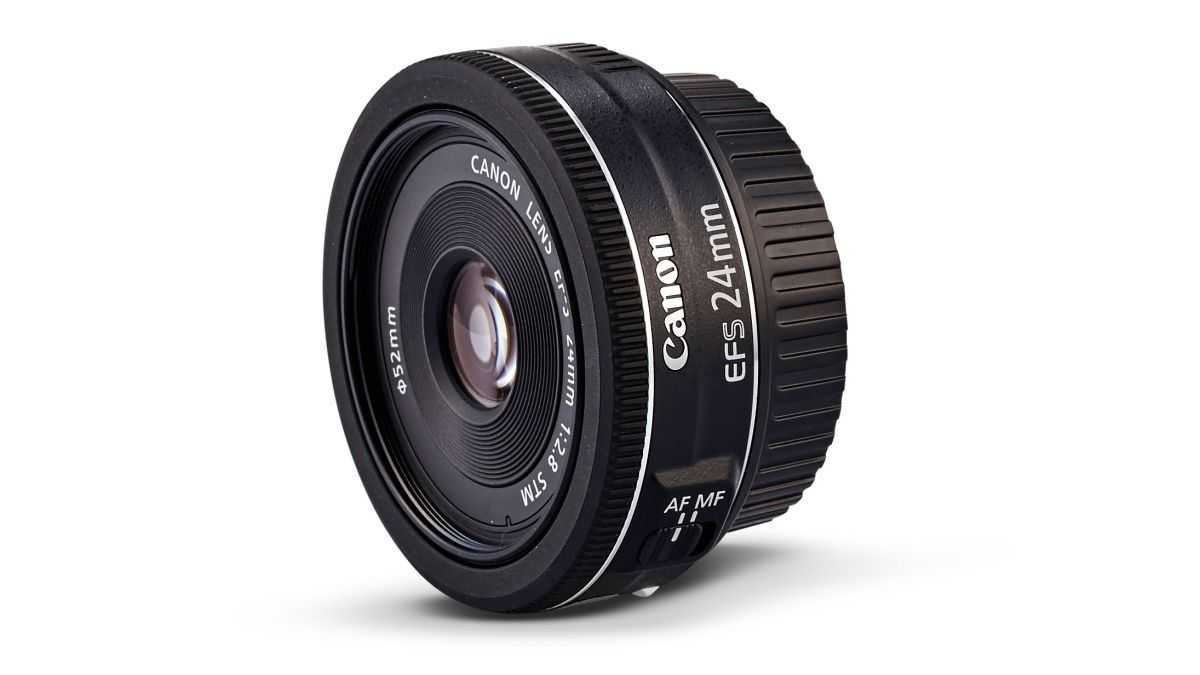
Weighing a mere 125g and measuring just 23cm in length, the Canon EF-S 24mm f/2.8 STM is the slimmest and lightest Canon EF-S lens ever produced. Being an EF-S lens, you can only use it on a Canon EOS APS-C body like the 7D Mark II that we tested it with, for a 38mm equivalent angle of view.
 The Canon EF-S 24mm f/2.8 STM lens mounted on an EOS 7D Mark II
 The Canon EF-S 24mm f/2.8 STM lens mounted on an EOS 7D Mark II
 The Canon EF-S 24mm f/2.8 STM lens mounted on an EOS 7D Mark II
As you would expect from such an inexpensive lens, build quality is adequate rather than outstanding. The Canon EF-S 24mm f/2.8 STM feels fairly solid in your hand, despite the all-plastic construction, and the metal mount is very welcome. As you’d expect on such a small lens, the focusing ring is very narrow but has a ridged, rubberised grip band that assists with the finger-tip operation.
 Front of the Canon EF-S 24mm f/2.8 STM lens
 Front of the Canon EF-S 24mm f/2.8 STM lens
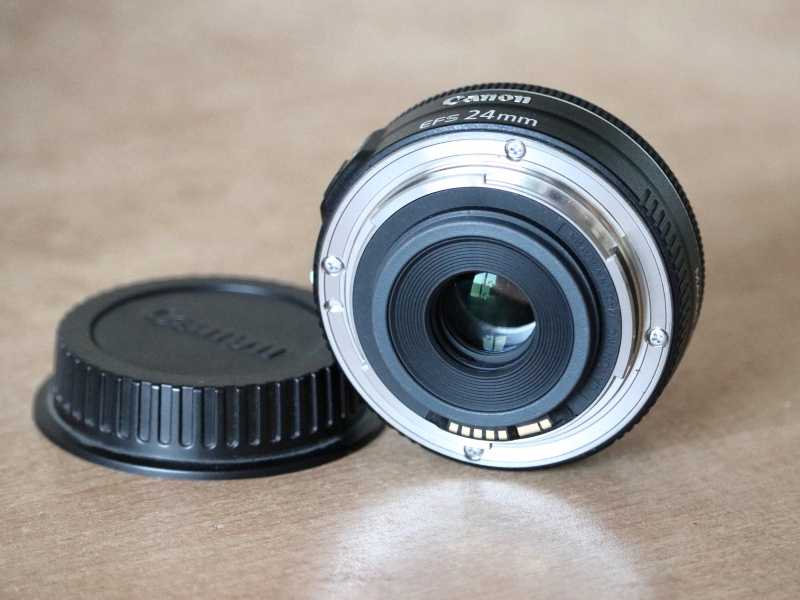
 Rear of the Canon EF-S 24mm f/2.8 STM lens
The final control on the lens barrel is a focus mode switch with the usual AF/MF settings. Note that this lens offers full-time manual focusing even when AF is selected.
 Front of the Canon EF-S 24mm f/2.8 STM lens
 Rear of the Canon EF-S 24mm f/2.8 STM lens
 The Canon EF-S 24mm f/2.8 STM lens in-hand
The lens doesn’t ship with either a lens hood or a protective bag. It accepts 52mm filters.
At the 24mm focal length the angle of view is 59º 10′.
 Field of view at 24mm
Focusing
The Canon EF-S 24mm f/2.8 STM lens has a very narrow focusing ring that doesn’t really encourage you to use it — perhaps Canon thinks that most users of this lens will never manually focus. There are no hard stops at either ends of the range, making it more difficult to set focus at infinity. Manual override of the autofocusing system is available at any time. Polariser users should be pleased that the 52mm filter thread doesn’t rotate on focus.
When it comes to auto-focusing, the Canon EF-S 24mm f/2.8 STM zoom is a quick performer, only taking about 0.15 seconds to lock onto the subject when mounted on the Canon EOS 7D Mark II that we tested it with. We didn’t experience too much «hunting» though, either in good or bad light, with the lens accurately focusing almost all of the time. It’s also a virtually silent performer too, thanks to the built-in STM (Stepping Motor), which makes this lens well-suited to video recording and more candid photography.
Chromatic Aberrations
Chromatic aberrations, typically seen as purple or blue fringes along contrasty edges, are pretty well controlled with this lens, only appearing in a few of our test shots. The examples below show the worst-case scenario.
Light Fall-off
With the lens wide open at f/2.8, you can see some obvious light fall-off in the corners, although Canon’s latest APS-C bodies can automatically correct for it when shooting JPEGs. There’s also some mild barrel distortion.
 Vignetting at 24mm
Macro
The Canon EF-S 24mm f/2.8 STM usefully doubles up as a macro lens, with the close-focus point 16cm/0.52ft from the film/sensor plane, and Canon quotes a maximum reproduction ratio of 0.27x. The following example illustrates how close you can get to the subject, in this case a CompactFlash card.
 Close-up performance
Bokeh
Bokeh is a word used for the out-of-focus areas of a photograph, and is usually described in qualitative terms, such as smooth / creamy / harsh etc. The Canon EF-S 24mm f/2.8 STM has an iris diaphragm with 7 rounded blades for a pleasing rendering of the out-of-focus highlights. Below you’ll find some examples, but you are also encouraged to check out our sample images.
Sharpness
In order to show you how sharp this lens is, we are providing 100% crops on the following page.
- Ease of Use
- Sharpness: 24mm
- Sample Images
- Lens Specs
- Rating & Conclusion
- Main Rivals
Chromatic Aberration
Chromatic aberration refers to the various types of “fringing” that can appear around high contrast subjects in photos—like leaves set against a bright sky. The fringing is usually either green, blue, or magenta and while it’s relatively easy to remove the offensive color with software, it can also degrade image sharpness.
The EF-S 24mm f/2.8’s wide-angle optical design yields slightly worse chromatic aberration than we’d like. Though the issue isn’t as severe as it is in some of Canon’s lower-end zooms, there’s moderate fringing at all apertures. It’s worst at f/2.8 in the image corners.
Build Quality & Features
This is a bare bones lens, but like the 40 STM, it feels well made.
The non-weather-sealed body is constructed of engineering plastic with a standard metal mount.
The other external components include a single switch, an extending inner lens barrel and a tiny MF ring.
The MF ring has very little play/wobble in its design.

MFD |
∞
w/ Hood: MFD |
∞
Rotated
Compare >
As already indicated, this is a diminutive and featherweight lens.
Here is a comparison table that will highlight these facts.
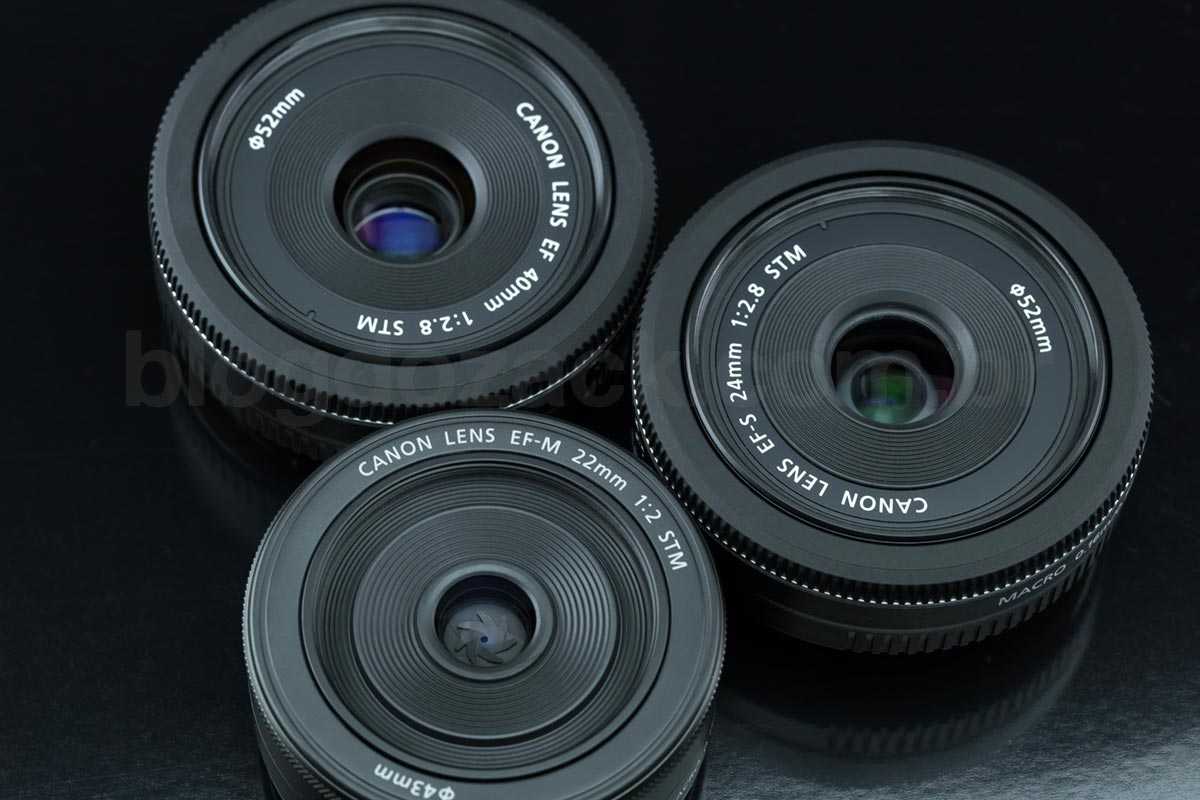


| Model | Weight | Dimensions w/o Hood | Filter | Year | ||
| Canon EF-M 22mm f/2 STM Lens | 3.7 oz | (105g) | 2.4 x 0.9″ | (60.9 x 23.7mm) | 43mm | 2012 |
| Canon EF 24mm f/1.4L II USM Lens | 22.9 oz | (650g) | 3.3 x 3.4″ | (83.5 x 86.9mm) | 77mm | 2008 |
| Canon EF 24mm f/2.8 IS USM Lens | 9.9 oz | (280g) | 2.7 x 2.2″ | (68.4 x 55.7mm) | 58mm | 2012 |
| Canon EF-S 24mm f/2.8 STM Lens | 4.4 oz | (125g) | 2.7 x 0.9″ | (68.2 x 22.8mm) | 52mm | 2014 |
| Canon EF 28mm f/2.8 IS USM Lens | 9.2 oz | (260g) | 2.7 x 2.0″ | (68.4 x 51.5mm) | 58mm | 2012 |
| Canon EF 35mm f/2 IS USM Lens | 11.8 oz | (335g) | 3.1 x 2.5″ | (77.9 x 62.6mm) | 67mm | 2012 |
| Canon EF 40mm f/2.8 STM Lens | 4.6 oz | (130g) | 2.7 x 0.9″ | (68.2 x 22.8mm) | 52mm | 2012 |
For many more comparisons, review the complete Canon EF-S 24mm f/2.8 STM Lens Specifications using the site’s Lens Spec tool.
Here is a visual comparison of some of these lenses:

Positioned above from left to right in their fully retracted positions are the following lenses:
Canon EF-S 24mm f/2.8 STM LensCanon EF 24mm f/2.8 IS USM LensCanon EF 28mm f/2.8 IS USM LensCanon EF 35mm f/2 IS USM LensCanon EF 50mm f/1.4 USM Lens
The same lenses are shown below in their fully extended states with their lens hoods in place.


The hood is not thick enough to add significant impact protection to the front element and the angle of view difference for light blocking is very small.
I’m a huge proponent of using lens hoods, but I don’t think this one is worth bothering with.
I’m also not sure that a lens this inexpensive justifies a protection filter, though
I would be lost without circular polarizer filters for all of my lenses and also frequently find
neutral density filters to be invaluable.
For these filter types, the small 52mm size is also reflected in the relatively small prices and a small form factor for that is easy for taking with you.
No case is included in the box, but finding somewhere to stow this lens should not be challenging.
Most clean pockets will work.
Image Quality
The EF-S 24mm f/2.8’s best feature is its consistent performance across the frame. From the center of the image to the corners, it offers consistent sharpness, and that sharpness doesn’t drop off considerably if you set the aperture wide open at f/2.8 or closed down past f/8, as some other lenses do. On the downside, it never gets as sharp as some of the better prime lenses in Canon’s lineup.

EXIF: 24mm, ISO 100, 1/160, f/2.8
The EF-S 24mm f/2.8 STM also has some minor issues with both geometric distortion and vignetting. The lens produces about 1.2% barrel distortion, meaning straight lines toward the edge of the frame will bow out slightly. There’s also some vignetting (darkening of the corners of the frame) at f/2.8. Chromatic aberration, which appears as colored fringing on high-contrast subjects, is the only other issue. It’s moderately apparent at all apertures, but worst at f/2.8.
 Credit:
Kyle Looney / Reviewed.com
EXIF: 24mm, ISO 100, 1/400, f/2.8
Altogether, if you’ve been laboring with the standard 18-55mm f/3.5-5.6 or 18-135mm f/3.5-5.6 kit lenses from Canon, this lens will feel like a breath of fresh air. It doesn’t provide the flexibility of optical zoom, but it’s smaller, lighter, (generally) sharper, and has that nice smooth, quiet focus motor. You’ll get better photos, better videos, and have a lighter camera that you’ll want to carry around more often.
Below, you can peruse sample photos shot with the EF-S 24mm f/2.8 STM lens mounted on a Canon 7D Mark II. Click the link below each photo if you want to pixel-peep a full-size version of a given shot.
{{ photo_gallery name=»Samples» }}
Canon EF-S 24mm f/2.8 STM Handling and Features

Being a pancake-type lens, this optic is remarkably compact and lightweight too, tipping the scales at only 125 grams. The lens barrel is constructed from high-quality plastics, finished with a silver ring around the front of the lens. As it is an EF-S lens, it can only be mounted on E-FS compatible Canon cameras, like the EOS 600D used for testing. The lens balances well with this camera, thanks to its compact size, making a good combination for travel.
Autofocus is very swift and precise and virtually silent. Unlike many of Canon’s USM lenses, full-time manual focus override is not possible and manual focusing is performed by the focusing motor. Manual adjustments can be made in single focus mode once the lens has locked onto a target. The manual focusing is only very lightly damped, which can make applying fine focus adjustments less easy than with lenses that have more resistance on the focus ring. A small switch on the side of the lens allows switching between manual and autofocus quickly.
The 52mm filter thread doesn’t rotate, making this lens ideal for use with polarising and graduated filters.

Price
The Canon EF-S 24mm f/2.8 STM Lens’ price is definitely one of my favorite features of this lens.
Few lenses cost this little and you can buy many of these lenses for the price of most other Canon lenses.
As Sean pointed out, this lens is worth the price just to add its video capabilities to the kit.
When the 24 STM was introduced, the Canon EF 40mm f/2.8 STM Lens was in the #1 position on my
Best Bargain Lens List.
Based on my expected performance of this lens, I strongly believed that the Canon EF-S 24mm f/2.8 STM Lens would join the 40 STM at the top of this list and that expectation was correct.
Which of these lenses should be #1? Flip a coin. I made it #2 because it was introduced after the 40.
And it is not full frame compatible.
As pointed out by a friend of the site, exchange rates seem to have been ignored in Europe where this lens costs 60-90% more than in the USA.
As I understand it, the review time street price for this lens is about 149 plus tax/VAT regardless of the £, € or $ currency.
While paying more is not fun, I still think that this lens is easily worth the price even across the big pond.

Distortion
We penalize lenses for distortion when they bend or warp your images image, causing normally straight lines to curve.
There are two primary types of distortion: When the center of the frame seems to bulge outward toward you, that’s barrel distortion. It’s typically a result of the challenges inherent in designing wide-angle lenses. When the center of the image looks like it’s being sucked in, that’s pincushion distortion. Pincushion is more common in telephoto lenses.
The EF-S 24mm f/2.8 STM exhibits mild to moderate barrel distortion, in line with a lens of its type. In our tests we recorded roughly 1.2% barrel distortion—detectable, but easy to correct with commonly available photo editing software. It’s not really much to worry about, and the in-camera correction available on most Canon DSLRs will take care of it for you.
Buy Now
Used Canon EF 500mm f/4.5 L USM
Heavily Used £799
Used Canon EF-S 17-85mm f/4-5.6 IS USM
Heavily Used £54
Used Canon EF-S 17-55mm f/2.8 IS USM
Heavily Used £199
Used Canon EF 55-200mm f/4.5-5.6 II USM
Heavily Used £54
Used Canon EF 70-200mm f/2.8 L USM
Like New £549
Used Canon EF 100mm f/2.8 L Macro IS USM
Like New £624
Used Canon EF 15mm f/2.8 Fisheye
Like New £354
Used Canon RF 24-240mm f/4-6.3 IS USM
Like New £814
Used Canon MP-E 65mm f/2.8 1-5x Macro
Like New £814
Used Canon EF 85mm f/1.4 L IS USM
Like New £1149
Sell or trade used photo and video kit with MPB
|
We don’t have the latest price however the link below will take you to the most relevant items. Canon EF-S 24mm f/2.8 STM |
We don’t have the latest price however the link below will take you to the most relevant items. Canon EF-S 24mm f/2.8 STM |
We transform the way that people buy, sell and trade in photo and video kit. USED CANON |
Support this site by making a Donation, purchasing Plus Membership, or shopping with one of our affiliates:
Amazon UK,
Amazon US,
Amazon CA,
ebay UK,
MPB. It doesn’t cost you anything extra when you use these links, but it does support the site, helping keep ePHOTOzine free to use, thank you.


ADVERTISEMENT
Other articles you might find interesting…
Nikkor Z DX 24mm F/1.7 Lens Review
Fujifilm XF 8mm F/3.5 Review
Canon RF-S 55-210mm Review
SIGMA AF 14mm f/1.4 DG DN | Art Lens Review
Best Third Party Nikon F Lenses (DSLR)
Astrodesign & Samyang Join The L-Mount Alliance
Best Canon EF And EF-S Lenses
Sony FE 70-200mm f/4 G OSS II Lens Announced — Take A Look A…
Summary
Canon likes to promote the incredible number of lenses they have produced.
This production figure far exceeds 100 million as I create the Canon EF-S 24mm f/2.8 STM Lens review.
Providing lenses like this one in their lineup will, very significantly, increase Canon’s production figures and marketing will be reaching production milestones at an even higher frequency.
The Canon EF-S 24mm f/2.8 STM Lens is an extremely small and light lens that produces very nice image quality and has accurate auto focus.
The price will seal the deal and make this a must-have lens for any APS-C kit.
At the end of the 40 STM review, I made a statement that also applies to this pancake-style lens: «Overall, I’m finding very «little» to not like about this tiny, inexpensive lens.»
It is fun to joke about this little lens, but … it is the real deal.
Not only will it get the job done, it will do the job as well or better than many other lenses. And for a lower price.
It is not hard to justify this purchase.
Bringing you this site is my full-time job (typically 60-80 hours per week). Thus, I depend solely on the commissions received from you using the links on this site to make any purchase. I am grateful for your support! — Bryan
My Recommended Canon EF-S 24mm f/2.8 STM Lens Retailers
Rent the Canon EF-S 24mm f/2.8 STM Lens
The Tip Jar
Canon EF-S 24mm f/2.8 STM Lens

- Sample Pictures
- Specifications
- Press Release
by Bryan Carnathan$20.00 Savings!
Manufacturer ID:9522B002Review Date: 2014-12-08
Navigate the Reviews« Canon EF 24mm f/1.4L II USM Lens Review» Canon TS-E 24mm f/3.5L II Tilt-Shift Lens Review
Canon & Sony News, Deals, Blog
- Bull Elk Hiding in a Pine Tree, Rocky Mountain National Park
… More Canon & Sony News
Introduction
The Canon EF-S 24mm f/2.8 STM is a new wide-angle prime pancake lens for Canon’s APS-C DSLR cameras. Featuring an equivalent focal length of 38mm, the Canon EF-S 24mm features a micro-stepping driver control for quieter operation for smooth and quiet continuous AF while capturing video and in live view mode, an aspheric lens element and optimized lens arrangement and coating to minimize ghosting and flare, a circular seven-blade aperture, full-time manual focus override, and a short minimum focusing distance of only 16cm. The Canon EF-S 24mm f/2.8 STM is available for £179.99 / €199.99 / $199.99.
Canon FL 135/3.5
Технические характеристики:
- Фокусное расстояние — 135 мм.
- Максимальная диафрагма — 3,5.
- Минимальная диафрагма — 22.
- Количество линз/групп — 4/3.
- Минимальная дистанция фокусировки — 1,5м.
- Количество лепестков диафрагмы —8.
- Байонетное крепление оптики — FL.
- Крепление для насадок и фильтров резьба — 48 мм.
- Тип просветление — однослойное.
- Рабочий отрезок — 41,9 мм.
- Фактический вес — 434 грамм.
Эргономика и конструктив:
Несомненным достоинством объектива можно считать его компактные размеры и не большой вес. Если по размерам сравнивать Canon FL с советским Юпитер-37А то у Ю-37А незначительный выигрыш, но только у Canon реализована прыгалка диафрагмы!
Кольцо установки диафрагмы вынесено на переднюю часть объектива (привет Zuiko OM). Переключается ступенями, но без промежуточных значений. В добавок объектив может похвастаться Репетиром диафрагмы, при использовании объектива через переходник на беззеркальных камерах нет необходимости разбирать объектив и фиксировать положения рычага.
Диафрагма состоит из восьми матовых черненных скругленных лепестков. На прикрытых значениях образуется восьмиугольник, но на диафрагмах 4.0-5.6 отчетливых углов нет, поэтому точечный свет в зоне нерезкости проявляется в форме вполне приемлемых кружком.
Широкое кольцо фокусировки прорезинено, даже влажные пальцы не скользят. От бесконечности до минимальной дистанции фокусировки нужно сделать Чуть более пол оборота. Ход геликоида немного туговат и избыточно вязкий. Сказывается сложная конструкция геликоида, состоящая из трех частей, две из них подвижны и имеют свою отдельную резьбу (подобный механизм у Юпитер-37А). Смотрите статью с переделкой canon FL 135/3.5.
Просветление оптики однослойное, но вполне не плохое. Сносно справляется с контровым светом — без фанатизма, прямой жесткий свет все же съест контраст и детализацию. Бленда рекомендуется, но бленду с резьбовым креплением 48мм нужно еще поискать.
Байонетное крепление FL не позволяет установить объектив при помощи переходника на цифровые зеркальные фотокамеры Canon-EOS Nikon Pentax Sony (Olympus исключение) с сохранением фокусировки на бесконечности. Для чего объектив Canon FL 135/3.5 необходимо переделывать, юстировать и менять хвост.
Художественные качества:
На открытой диафрагме объектив резкий, но немного хроматит. Хроматические аберрации в виде фиолетовой каймы формируется вокруг белых объектов, а так же можно наблюдать кайму вокруг веток деревьев (и подобного) при контровом свете по краю изображения.
Помимо того картинка достаточно контрастная. Что не удивительно, оптическая схема Sonnar. Я бы сказал что она такая же как и у Carl Zeiss Sonnar 135/3.5 и Юпитер-37А, но все же задняя последняя линза не двуяковыпуклая а вогнуто-выпуклая — мениск. Что заметно отличает картинку, в частности БОКЕ отличается. Теперь картинка не имеет плавного перехода из ГРИП в зону нерезкости, а с явным переходом. По мнению разработчиков Canon, так правильно. Собственно Canon Co. построила всю оптическую иерархию вокруг правильной — резкой, контрастной, без явных недостатков картинки.
Однослойное просветление вносит незначительную лепту в искажения цветов. Все вполне естественно но блекло. Как писалось выше, прямой контровый жесткий свет не желателен.
Вывод:
Canon FL 135/3.5 классический представитель Sonnar-овской братии, но с чертами Canon. Резкая, контрастная, без искажений, с небольшими хроматическими аберрациями (ХА) картинка — очень «правильная» картинка, возможно кому то покажется что суховата. Объектив достаточно компактен и легок, переделывается на Nikon. На наших просторах не плохая альтернатива Юпитеру-37А за те же деньги (или даже доступнее).
Sharpness
A lens’s sharpness is its ability to render the finest details in photographs. In testing a lens, we consider sharpness across the entire frame, from the center of your images out to the extreme corners, using an average that gives extra weight to center performance. We quantify sharpness using line widths per picture height (LW/PH) at a contrast of MTF50.
 Credit:
Reviewed.com / Chris Thomas
Even at peak sharpness, the lens isn’t so great.
When shooting in the RAW file format on the Canon 7D Mark II the EF-S 24mm f/2.8 STM fails to match up to the best prime lenses on the market. In the image center, the lens was only able to resolve about 1,300 lines at f/2.8, though that figure improves to around 1,500 lines at f/5.6 and f/8. That’s what we’d call an acceptable result, though its full-frame equivalent, the EF 40mm f/2.8, showed better overall results on the full-frame EOS 5D Mark III.
 Credit:
Reviewed.com / Chris Thomas
Wide open, this is merely a fair lens.
In the midway and corner regions of the frame, the 24mm f/2.8 fared a bit worse. In both regions the results hovered around 1,100 lines wide open, which is acceptable, but not great. The corners improved to 1,400 lines at f/5.6 and f/8, but the middle region never showed much improvement at all. It would be a troubling result in a larger, more expensive lens, but realistically you’re buying this lens for its compact design, not world-beating performance.


Focal Length / Focal Length Range
As you have likely already figured out, this is a 24mm fixed focal length (prime) lens.
To say that the 24mm focal length is popular could be considered an understatement as Canon’s lens lineup alone includes 4 prime 24mm lenses and 15 zoom lenses with the 24mm focal length included.
That is 19 out of about 78 total current lenses or about 25% of Canon’s lenses containing the 24mm focal length.
With the «EF-S» qualification, we know that this lens provides an image circle large enough to cover only an APS-C sensor.
APS-C format cameras compatible with EF-S lenses include the Rebel (***D and ****D) models, **D models (such as the 70D) and the 7D series.
These cameras have a 1.6x FOVCF that provides an angle of view from a 24mm lens that is similar to that of a 38.4mm lens on a full frame camera.
This is what that angle of view looks like:

Shown in this picture is the US Coast Guard Taney docked in Inner Harbor, Baltimore.
A 20 second f/8 exposure at ISO 100 was used for this image.
A 38.4mm lens is modestly wider angle than the 50mm focal length that is most often considered the «normal» or «standard» focal length and only very slightly longer than the also-wildly-popular 35mm focal length.
These focal lengths are not greatly dissimilar and their lists of uses have significant overlap, but there is a perspective difference when framing a subject similarly.
Below is a full frame comparison I created for the EF 40mm STM Lens review that shows this difference.
APS-C-equivalent focal length angle-of-views are included in parenthesis after the actually-used focal lengths with the 25mm example being the relevant example for this review.

35mm (APS-C: 22mm) |
40mm (APS-C: 25mm) |
50mm (APS-C: 31mm)
In this example, the sides of the frame are nearly identical for each shown focal length,
but the large trees in the background change size greatly in proportion to the foreground due to the different focus distances required for the similar framing.
The wider angle lens will emphasize what is closer to the camera in relation to the background.
The wider angle lens will also emphasize human subjects’ closest parts — often noses — making them noticeably larger in relation to the rest of bodies if used at a close distance.
A 24mm lens is not a good choice for head shots (unless a distorted perspective is what you are going for).
Step back and your subjects will be happier with their portraits.
Portraits not framed tightly are going to be only one of a huge range of great uses for this lens.
The 24mm focal length is one that you could leave mounted for general purpose needs.
Aperture
Adding to the 24 STM’s multipurpose capabilities is the relatively wide f/2.8 aperture.
While not especially wide for a prime lens in this focal length, f/2.8 is as wide as zoom lenses get with the Sigma 18-35mm f/1.8 DC HSM Art Lens
being the sole exception at review time.
To get a wider aperture lens into a kit is a great reason for selecting a prime lens and f/2.8 is a full stop wider (letting in twice as much light) than a typical kit lens covering 24mm
(the EF-S kit lenses are typically f/4 max at 24mm).
An f/2.8 aperture is usually what I consider to be the minimum for stopping motion indoors or for night sky photography.
Following is an example showing the depth of field at full stop aperture changes.

f/2.8 |
f/4.0 |
f/5.6 |
f/8.0 |
f/11.0
Having only a 24mm focal length available generally disqualifies a lens for bird photography, but the 24 STM performed stellarly in this case.
To keep this review a reasonable length, I’ll share the complete cardinal picture story here.
Notable is that the f/2.8 aperture can create some background blur with a close subject and a distant background, but the amount of blur is not extreme.
